Restaurant Price History: The Secret to Protecting Your Profit Margin
Do you know how much each dish actually costs you today compared to last month? Discover Tavolas new ingredient and recipe price history tracking.
In the hospitality industry, profit margins are razor-thin. A small price increase in olive oil, salmon, or avocado might seem insignificant at first glance. However, when multiplied across hundreds of covers a week, it can silently devour your business's profitability. The biggest challenge for most restaurants isn't inflation itself, but a **lack of visibility**. Many owners do not realize that a menu item has stopped being profitable until it is too late and the monthly numbers do not add up. At Tavola, we want you to have absolute control. That is why we are excited to introduce our new key feature: **Ingredient and Recipe Price History Tracking**. --- Our platform automatically and continuously tracks the evolution of prices across your entire inventory in the background. Every time you upload a delivery note or invoice (either via chat or using the new bulk upload screen), Tavola’s AI engine does the following: 1. **Extracts purchase data:** It reads the ingredient name, quantity, format, and current unit price. 2. **Updates your ingredient sheet:** It registers the new price for the ingredient. 3. **Saves the history:** Instead of simply overwriting the previous value, Tavola logs the old price, the new price, and the exact date of the change. 4. **Recalculates recipe costs over time:** Automatically, Tavola computes how this change affects every single recipe and sub-recipe where that ingredient is used, creating a visual cost timeline for each dish. 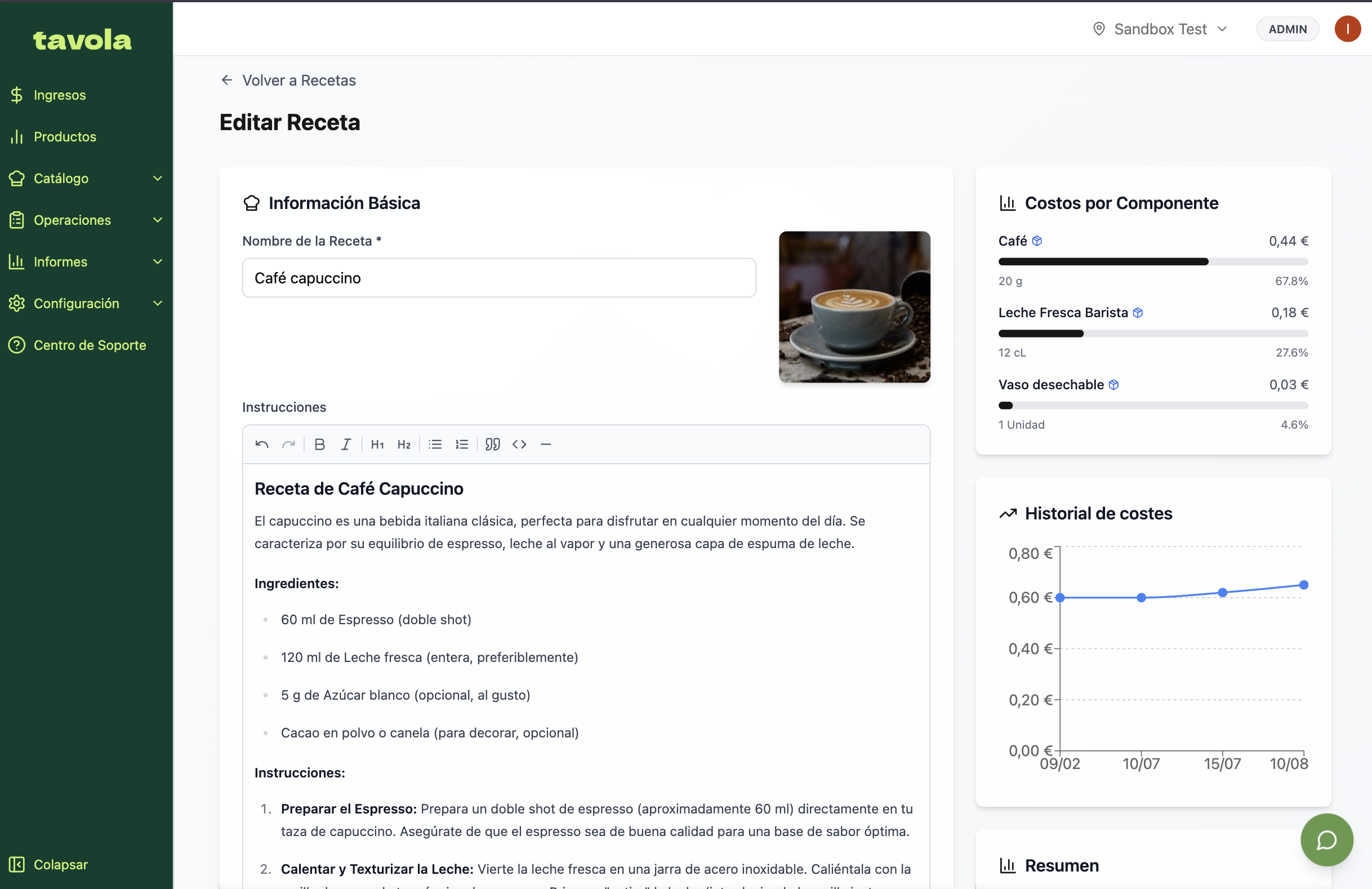 --- Having a detailed history of cost fluctuations for your dishes and raw materials gives you management superpowers in four critical areas: Many suppliers gradually increase prices on standard ingredients by a few cents at a time. Because it is not a sudden jump, it goes unnoticed in daily operations. With Tavola's price history, you can graphically visualize price trends for any ingredient and see exactly when and by how much it has increased. When an ingredient price spikes, your recipe cost increases. By looking at a dish's history (for instance, your *Gourmet Salmon & Avocado Salad*), you can see if its unit cost has risen from $3.50 to $4.80. Armed with this data, you can make immediate, informed decisions: * Adjust the selling price on the menu. * Modify the portion size of the more expensive ingredient. * Temporarily swap the ingredient for a seasonal alternative. Are you meeting with your distributor to negotiate rates for